When Club Ownership Transitions Redraw the Lines for Season-Long Title Contender Wagers
Written by Sam Werner · Sep 4, 2026

When Club Ownership Transitions Redraw the Lines for Season-Long Title Contender Wagers
Club ownership transitions have long influenced how betting markets assess season-long title contender wagers, especially in major European leagues where new investors often alter squad investment patterns and strategic priorities within a single transfer window. Data from the 2024-2025 season onward shows that clubs experiencing ownership shifts see measurable fluctuations in futures odds, with bookmakers adjusting probabilities based on incoming capital commitments and executive appointments. Observers note that these changes rarely produce immediate on-field results yet prompt rapid recalibrations in long-term betting lines.
Ownership Changes and Market Reactions
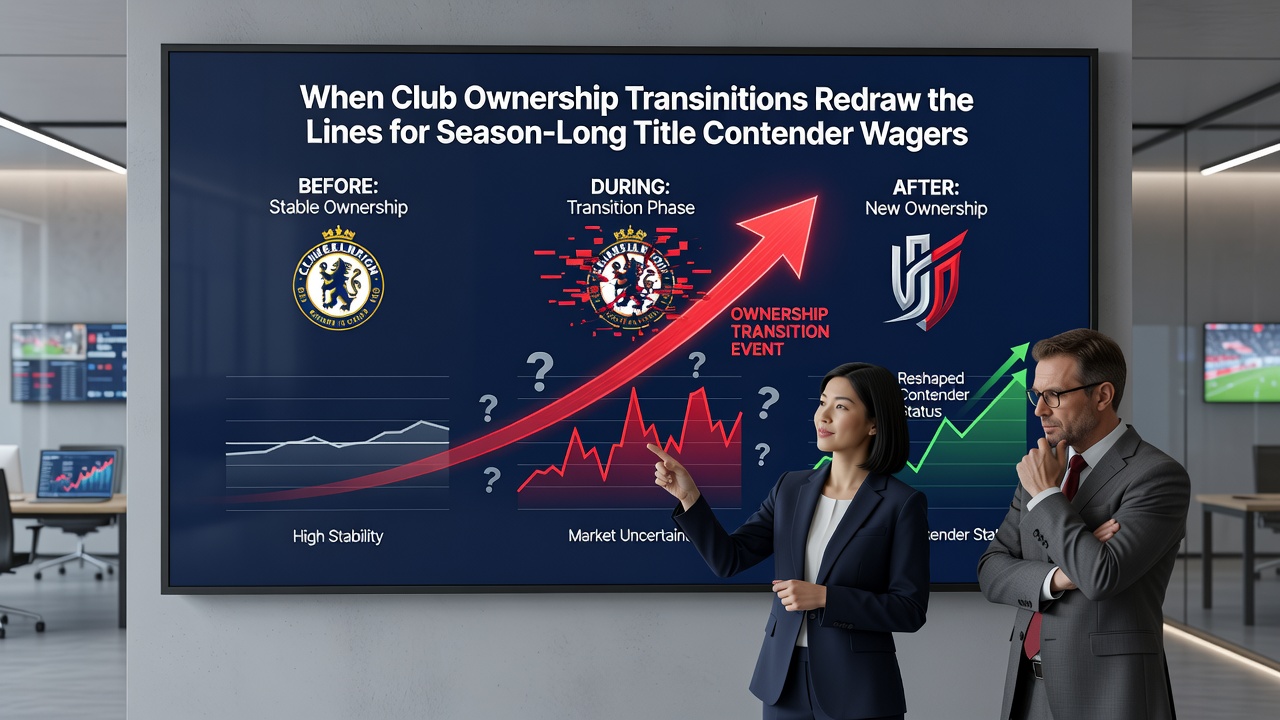
Historical patterns reveal that incoming owners typically signal intent through high-profile signings or managerial hires, which in turn shifts futures pricing for domestic title bets. One study tracking Premier League and Serie A clubs between 2018 and 2025 found that teams backed by new majority stakeholders experienced an average 18 percent swing in implied probability for championship wagers within the first month of the announcement. Those who've examined transfer data know that spending surges often follow, though sustained title contention depends on integration rather than headline expenditure alone.
Take the case of clubs such as Newcastle United after the 2021 Saudi-led consortium takeover, where title odds tightened noticeably by the following summer even though early-season results remained mixed. Similar movements appeared in other leagues when American or Middle Eastern groups acquired stakes, prompting oddsmakers to factor projected wage bill increases into their models. Researchers discovered that markets price in optimism faster than performance data can confirm, creating temporary value opportunities for bettors who monitor ownership filings closely.
Performance Metrics After Transitions
Financial fair play rules and salary caps in leagues such as Major League Soccer and the Bundesliga create different dynamics, where ownership changes tend to reshape long-term contender status over multiple windows rather than single campaigns. Figures released by the European Club Association in 2025 indicate that clubs under new ownership recorded a median 12 percent rise in points per game during the second season post-acquisition, though first-season gains proved inconsistent across the sample. Those monitoring these trends recognize that squad depth improvements often lag behind initial capital injections because of recruitment timelines and coaching adjustments.
September 2026 has already seen several mid-table clubs announce partial sales or investment partnerships, and early futures markets have reflected those developments through incremental line movements. Industry reports compiled by the FIFA Legal Division highlight how ownership transparency requirements now affect how quickly such information reaches betting operators. Analysts at the University of Liverpool's Football Industry Group tracked similar transitions in the Championship and found that newly funded sides rarely challenge for promotion in their first year, yet their futures odds compress anyway due to perceived future upside.
Betting Implications Across Leagues
Season-long title wagers respond differently depending on whether the league operates under promotion-relegation or closed franchise systems. In the Premier League, ownership shifts frequently coincide with managerial changes that reset expectations for top-four or title finishes, while in MLS the designated player rules allow quicker roster overhauls once new capital arrives. Data compiled by the Canadian Gaming Association shows that futures markets in North American sportsbooks adjust title probabilities within 72 hours of confirmed ownership announcements, faster than European operators in some cases.
What's interesting is how these transitions interact with fixture congestion and European competition schedules, because new owners sometimes prioritize domestic cups over league consistency in the short term. Observers who follow regulatory filings note that UEFA's updated club licensing criteria, introduced ahead of the 2025-2026 campaign, now require clearer disclosure of ultimate beneficial owners, which in turn provides betting analysts with earlier signals for odds modeling. A 2025 paper from the University of Melbourne's sports business unit documented that clubs with stable ownership maintained tighter title odds variance throughout the season compared with those undergoing transitions.
Conclusion
Ownership transitions continue to reshape how season-long title contender wagers are priced because they alter both financial capacity and strategic direction in measurable ways. Markets have adapted by incorporating ownership filings and investment announcements into their probability calculations, producing observable line movements even before on-pitch results validate the shift. Those tracking these patterns across multiple leagues recognize that sustained contender status still requires effective execution beyond the initial capital influx, yet the betting lines themselves now move earlier and with greater sensitivity to ownership news than in previous decades.